Table of Contents
Life insurance is one of those topics that most people know they should address — and then put off for years. A 2025 LIMRA study found that 41% of Americans have no life insurance at all, and among those who do, many carry far less coverage than their families would actually need. The hesitation is understandable: the industry is full of jargon, pushy salespeople, and products that seem designed to confuse.
This guide strips away the complexity. You will learn the two fundamental types of life insurance, how to calculate the right coverage amount for your situation, what you should expect to pay based on your age and health, and the red flags to watch for when shopping for a policy.
Why You Need Life Insurance
If anyone depends on your income — a spouse, children, aging parents, or even a business partner — you need life insurance. It replaces your financial contribution if you die, covering everything from the mortgage and daily living expenses to your children's future college tuition. Even a stay-at-home parent should carry coverage: the replacement cost of childcare, housekeeping, and household management easily exceeds $40,000 per year.
If you are single with no dependents and enough savings to cover your funeral and any debts, you may not need life insurance right now. But if you plan to have a family someday, locking in a policy while you are young and healthy will cost you a fraction of what you would pay later. A healthy 25-year-old can secure a 30-year, $500,000 term policy for about $28 per month.
Term Life Insurance: Simple and Affordable
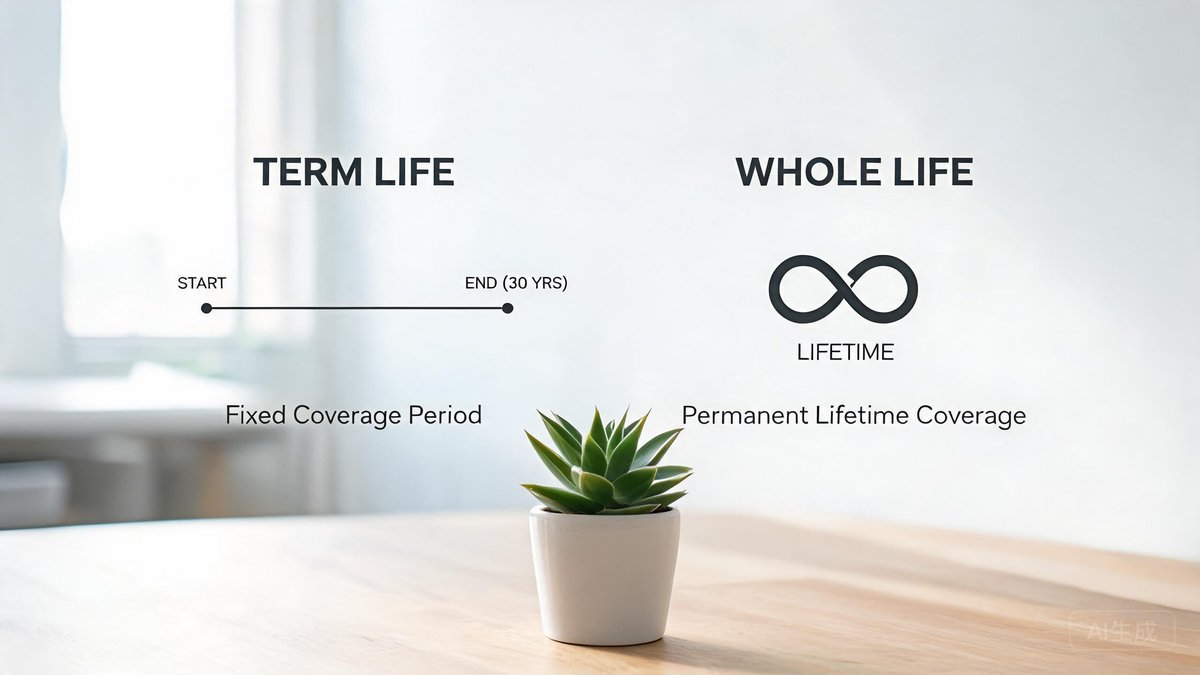
Term life insurance is exactly what it sounds like: coverage for a set period — typically 10, 20, or 30 years. If you die during that term, the insurer pays your beneficiaries the full death benefit. If you outlive the term, the policy expires and pays nothing. That simplicity is why term life is the right choice for roughly 90% of people who need coverage.
Term policies are priced based on your age, health, and the length and size of the policy. A 30-year-old in good health can expect to pay around $22 to $35 per month for a 20-year, $500,000 term policy. A 45-year-old buying the same policy might pay $65 to $90 per month. The math is straightforward: buy coverage when you are young and healthy, lock in level premiums for the full term, and invest the money you save versus buying a more expensive permanent policy.
Most families should aim for a term length that covers their remaining working years, or until their youngest child finishes college — whichever is longer. For a 35-year-old with a newborn, a 25-year or 30-year term policy covers the child through college graduation. By the time the policy expires, your mortgage should be paid down, your retirement accounts should be substantial, and your dependents should be self-sufficient. The insurance becomes unnecessary — and that is the goal.
Quick Tip: Always buy level term, where the premium stays fixed for the entire term. Avoid "annual renewable term," which starts cheap but gets more expensive every year you renew. The low first-year price is a trap.
Whole Life Insurance: Coverage That Lasts
Whole life insurance is a form of permanent insurance — it covers you for your entire life, not a fixed term, as long as you keep paying premiums. It also includes a cash value component that grows over time on a tax-deferred basis. You can borrow against this cash value or, in some cases, withdraw it. That dual purpose makes whole life significantly more expensive: expect to pay 5 to 10 times more than an equivalent term policy for the same death benefit.
A 35-year-old buying $500,000 of whole life coverage might pay $400 to $600 per month, compared to $30 to $45 for a 30-year term policy with the same benefit. The sales pitch is that you are "investing" the difference, and the cash value will eventually offset the higher cost. In practice, the returns on the cash value portion are modest — typically 2% to 4% annually in the early years, creeping up slowly over decades.
Whole life makes sense in a few specific scenarios. High-net-worth individuals sometimes use it as an estate planning tool to pass wealth to heirs tax-free. Business owners use it to fund buy-sell agreements. And people with lifelong dependents — such as a child with special needs — may need permanent coverage that never expires. For everyone else, buying term and investing the difference in low-cost index funds will almost always leave you with more wealth at retirement.
How Much Coverage Do You Actually Need
The most common rule of thumb is 10 to 12 times your annual income. If you earn $60,000, that suggests $600,000 to $720,000 in coverage. It is a reasonable starting point, but a more precise calculation looks at your specific obligations rather than a blunt multiple of income.
Add up these numbers to get your target coverage:
- Outstanding debts: mortgage balance, car loans, student loans, credit cards
- Income replacement: your annual after-tax income multiplied by the number of years your family would need support (typically 10 to 15 years)
- Education costs: four years of in-state public university currently runs about $100,000 per child, including room and board
- Final expenses: funeral and burial costs average $7,000 to $10,000
Subtract your current savings, existing life insurance through work, and Social Security survivor benefits (which can be meaningful for families with young children). The remaining gap is what you need to insure. A typical family with young children, a mortgage, and moderate savings often needs $500,000 to $1,000,000 in total coverage.
What Determines Your Premium
Insurance companies assess risk using a process called underwriting. Several factors directly affect what you pay:
Age is the largest factor. Premiums increase roughly 8% to 10% per year that you delay buying. A policy purchased at 30 costs dramatically less than the same policy bought at 45, even if both buyers are in perfect health.
Health status includes your medical history, current conditions, height and weight, blood pressure, and cholesterol levels. Insurers typically assign you to a risk class: Preferred Plus (the best rates), Preferred, Standard Plus, or Standard. Smokers pay 2 to 3 times more than nonsmokers for the same coverage, and quitting for at least 12 months usually qualifies you for nonsmoker rates.
Occupation and hobbies can raise your premium or even disqualify you. Pilots, commercial fishermen, roofers, and offshore oil workers pay more. High-risk hobbies like skydiving, scuba diving below certain depths, and motorcycle racing also increase rates. Be honest on your application — if you die doing something you failed to disclose, the insurer can deny the claim.
The medical exam is standard for most policies above a certain threshold. A paramedical professional comes to your home or office, takes blood and urine samples, checks your blood pressure, and records your height and weight. The exam takes about 20 minutes and is paid for by the insurer. Some companies now offer "no-exam" policies using algorithms and existing medical records, but these typically cost more and cap coverage at lower amounts.
How to Choose the Right Policy
Start by getting quotes from at least three insurers. Premiums for the same coverage can vary by 30% or more between companies because each weights risk factors differently. Use an independent broker who works with multiple carriers rather than a captive agent who sells for only one company. Brokers have access to a wider range of products and can help you compare.
Check the insurer's financial strength rating through AM Best, Moody's, or Standard & Poor's. You want a company rated A or better by AM Best — this means the insurer has the financial reserves to pay claims decades from now. Avoid companies with ratings below A-, regardless of how cheap their premiums look.
Read the policy carefully before signing. Pay special attention to the exclusions (what is not covered) and the contestability period — typically the first two years, during which the insurer can investigate and deny claims if they find misrepresentations on your application. Suicide clauses, which exclude death by suicide within the first two years, are also standard in most policies.
Once your policy is in force, review it every three to five years or after major life changes: marriage, divorce, a new baby, buying a house, or a significant income change. You may need to increase coverage or, in some cases, reduce it. Life insurance is not a set-and-forget product — your needs shift as your life does.
Key Point: Employer-provided life insurance is a nice bonus — but it should not be your only coverage. Group policies are tied to your job, meaning if you leave or get laid off, you lose the coverage. A private policy stays with you regardless of employment.
Building a robust savings habit is the foundation of financial independence, yet most people never develop a systematic approach to saving. The most effective strategy is to automate your savings so the money moves out of your checking account before you have a chance to spend it. Setting up an automatic transfer on payday to a dedicated savings account removes the willpower element entirely. Financial advisors typically recommend saving at least 15 to 20 percent of your gross income for long-term goals. If that seems impossibly high, start with 5 percent and increase it by one percentage point every three months. The gradual ramp-up is barely noticeable in your daily spending but produces dramatic results over a working career due to the power of compound growth.